
To organize camping gear storage at home, match two things: how often you use each item, and whether your storage space is climate-controlled. Gear you grab weekly goes in the closest climate-controlled spot, like an entry closet. Gear used a few times a year can move to a garage or shed shelf. Moisture-sensitive items (tents, sleeping bags) always go to the driest, most stable space you have, regardless of how often you use them.
Key Takeaways
- Decide storage location using two factors together: access frequency (weekly, seasonal, or rarely) and whether the space is climate-controlled, not just “whatever’s closest.”
- Tents and sleeping bags should never be stored compressed in their stuff sacks long-term; both need a loose, breathable bag and a cool, dry spot, per REI’s own care guides.
- The EPA’s mold-prevention guidance applies directly to gear storage: keep the space below 60% relative humidity (ideally 30-50%), and dry anything damp within 24-48 hours.
- This hub links to nine supporting guides: garage zoning, shed vs. garage vs. closet, apartment storage, seasonal checklists, mold prevention, trip-type kits, pre/post-trip checklists, self-storage vs. home storage, and decluttering.
- No single storage location is “best” for every household; the right system usually combines two or three of these locations based on what gear you own and how often you use it.
How Do You Organize Camping Gear Storage at Home? Start With This Decision System
Most articles on this topic give one set of tips for one location: “here’s how to organize your garage” or “here’s how to use your closet.” That misses the real question, which is which location fits which piece of gear. The graphic and table below answer that with two variables: how often you reach for the gear, and whether the space available to you is climate-controlled (an interior closet, spare room, or finished basement) or not (a typical unheated garage, shed, or attic).
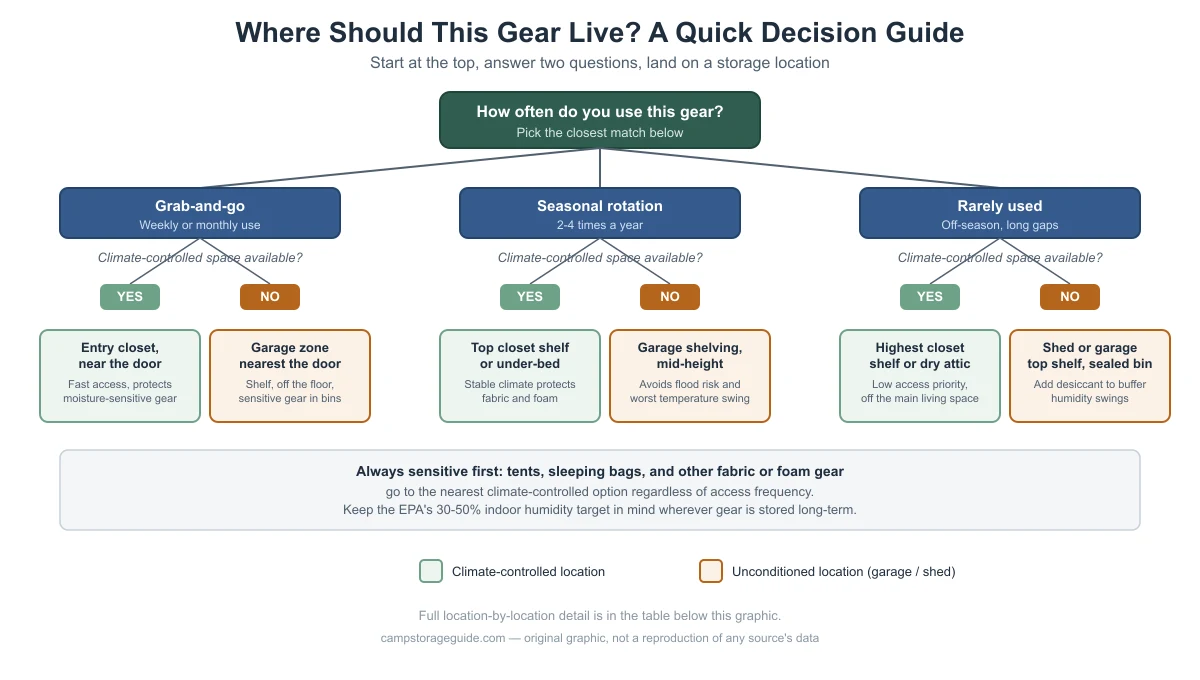
| Access frequency | Climate-controlled space available? | Best location | Why it works |
|---|---|---|---|
| Grab-and-go (weekly/monthly) | Yes | Entry closet or hall closet near the door | Fastest access on your way out, and the stable indoor climate protects fabric and foam gear |
| Grab-and-go (weekly/monthly) | No (garage/shed only) | Garage zone nearest the door, on a shelf, off the floor | Still quick to reach; keep anything moisture-sensitive in a closed container, not loose on a shelf |
| Seasonal rotation (2-4x/year) | Yes | Top closet shelf, under-bed storage, or a spare-room zone | Doesn’t need daily access, and the stable indoor climate avoids the humidity swings that damage fabric and foam over a full season |
| Seasonal rotation (2-4x/year) | No | Garage shelving at mid-height, away from exterior walls | Mid-height avoids both flood risk near the floor and the most extreme temperature swing near an uninsulated ceiling |
| Rarely used / long off-season | Yes | Highest closet shelf, or a dry, insulated attic | Lowest access priority, so it can sit in the least convenient indoor spot |
| Rarely used / long off-season | No | Shed or garage top shelf, in a sealed bin with a desiccant packet | The sealed bin and desiccant buffer the gear against the bigger humidity and temperature swings of an unconditioned space |
One override rule beats every row above: if an item is especially sensitive to moisture, such as a tent, a sleeping bag, or anything with down or synthetic insulation, send it to the nearest climate-controlled option even if you’d normally store it in the garage or shed by frequency alone. The “why” section below explains exactly why that override matters.
How Do You Organize a Garage for Camping Gear?
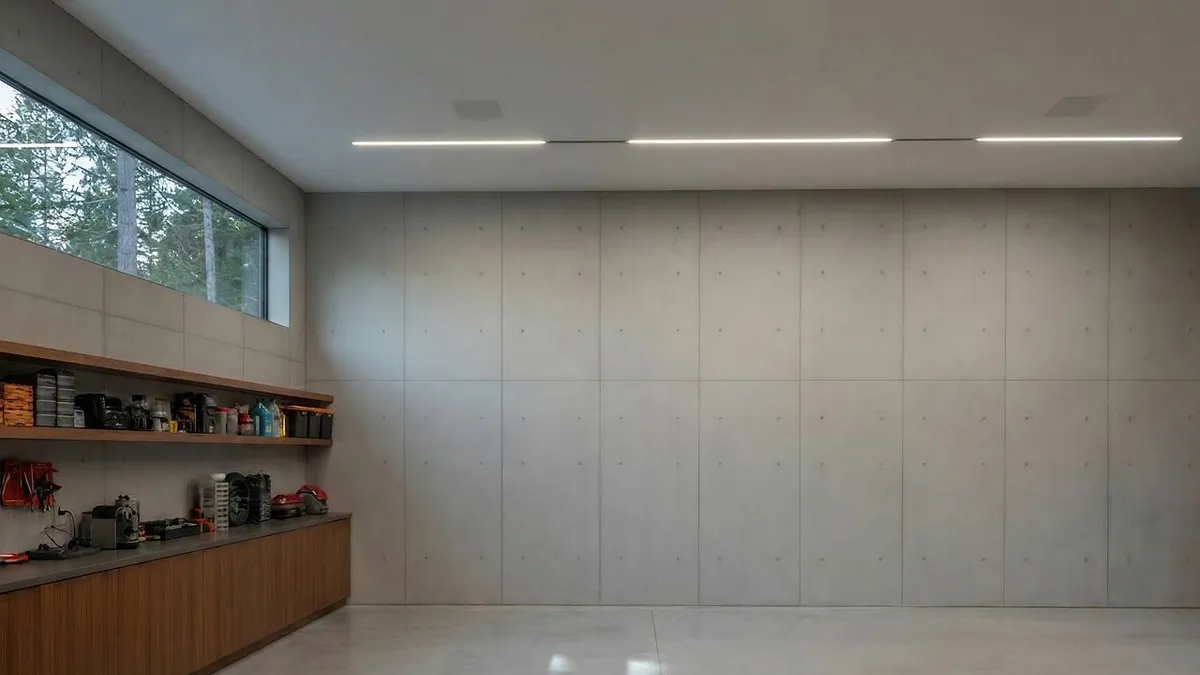
A garage works well for camping gear as long as it’s zoned instead of treated as one big pile. Group gear into zones by how often you grab it: a “grab-and-go” zone near the door for weekend kits, a mid-height shelving zone for seasonal gear, and a high or back-corner zone for rarely used items. REI’s own storage tips recommend a multi-shelf rack to consolidate gear in one place and clear containers instead of opaque ones, simply because you can see what’s inside without opening every container. Our full walkthrough, How to Organize a Garage for Camping Gear (Zone-by-Zone Plan), covers the exact zone layout and a “time-to-grab” rule for deciding what goes where.
Is a Shed, Garage, or Closet Better for Camping Gear?
Each location trades off differently on temperature swing, moisture risk, pest risk, security, and access speed. A detached shed usually sees the widest temperature and humidity swings unless it’s insulated and vented, which makes it the riskiest spot for fabric and foam gear but fine for hard-sided items like coolers and folding furniture. A garage sits in the middle: better insulated than most sheds (especially if it’s attached to the house), but still subject to seasonal extremes most interior closets never see. An interior closet is the most stable option climate-wise, but it’s also the most space-limited.

If you have all three spaces available, the practical split is: climate-sensitive and frequently used gear goes in the closet, bulky and climate-tolerant gear (folding chairs, coolers, hard cases) goes in the shed or garage, and everything in between goes wherever has space at mid-height, away from the floor and exterior walls. For a full side-by-side scorecard across all five factors, see Shed vs. Garage vs. Closet: Where Should You Store Camping Gear?
How Do You Store Camping Gear in a Small Apartment?
Without a garage or shed, the system shifts to vertical space and multi-use furniture: a closet rod for hanging packs and sleeping bags, under-bed storage for bulkier flat items, and over-door or wall hooks for smaller gear, all without needing to drill into rental walls. REI’s gear-storage tips specifically call out hanging packs, sleeping pads, and sleeping bags from hangers or hooks inside a closet, and using a rod between two shelf units when closet space runs out. The tradeoff in an apartment is volume, not climate — most apartments are already climate-controlled, so the bigger challenge is fitting everything into a smaller footprint. Our dedicated guide, How to Store Camping Gear in a Small Apartment, breaks this down space by space with real dimensions for a studio or one-bedroom.
How Do You Stop Mold and Mildew From Ruining Stored Gear?
Moisture, not location, is the real enemy, and it’s preventable with the same few habits in any location. REI’s own tent care guide is direct about this: a tent must be fully dry before it goes into storage, because mildew can start forming on damp fabric within a single day, and that mildew both smells bad and breaks down a tent’s waterproof coating over time. The fix is to pitch or hang the tent until it’s completely dry before packing it away, never to fold a damp tent “to deal with later.”
Storage container matters too, in the opposite direction from what most people assume. REI recommends storing both tents and sleeping bags loosely, not compressed in their travel stuff sacks, using an oversized breathable cotton or mesh bag (a king-size pillowcase works for a sleeping bag in a pinch). Long-term compression in a tight stuff sack damages a sleeping bag’s insulation loft, which reduces how warm it keeps you over time. If your only available storage space is damp, such as a basement or an uninsulated shed, REI’s tent guide suggests a sealed plastic bin as a second line of defense once the gear itself is fully dry.
Behind both of these tips is a simple number from the U.S. Environmental Protection Agency: keep indoor humidity below 60% relative humidity, ideally between 30% and 50%, and dry anything wet or damp within 24 to 48 hours. The EPA is blunt about the core principle: moisture control is mold control. A cheap humidity meter in your gear storage area tells you in seconds whether you’re in a risk zone.
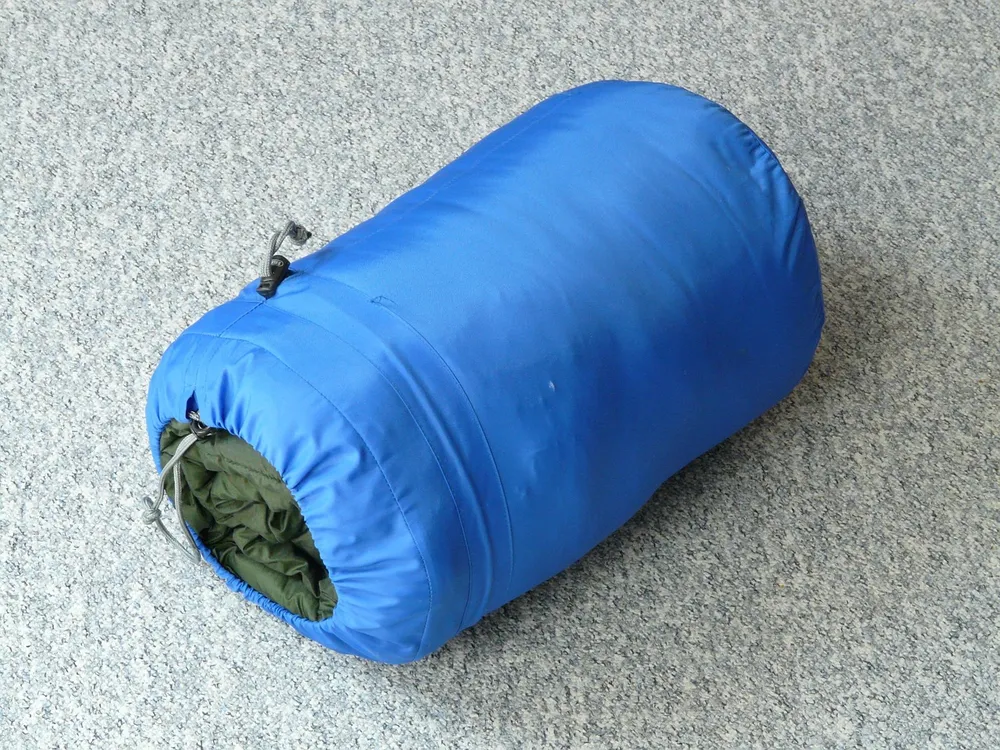
A tightly rolled stuff sack like the one above is exactly right for the trail and exactly wrong for long-term storage; swap it for a loose, breathable bag the moment you’re home. For a full location-by-location moisture plan, including specific humidity setups for garages, sheds, closets, and apartments, see How to Prevent Mold and Mildew on Stored Camping Gear.
Should You Organize Gear by Season or by Trip Type?
Both, and they solve different problems. Seasonal organization answers “what do I pack away until next year?” — moving winter-only gear out of reach in spring and summer gear out of reach in fall, with a clean-dry-inspect-repack routine at each swap. Trip-type organization answers a different question: “what do I grab for this specific trip?” A car-camping trip, a backpacking trip, a quick overnight, and a trip with kids all call for a different kit, and pre-building those kits saves you from re-packing the same gear from scratch every time. Our Seasonal Camping Gear Storage Checklist (Pack-Away Guide) covers the month-by-month pack-away routine, and How to Organize Camping Gear by Trip Type (Grab-and-Go Kits) covers building kits that stay ready between trips.
How Do You Build a Pre-Trip and Post-Trip Checklist System?
A checklist you rewrite from memory every trip is where storage systems usually break down, because gear gets put back in the wrong place or left out to deal with “later.” A two-sided checklist that lives inside the gear kit itself — a pull list before you leave, and a teardown and restock list the moment you’re home — keeps the system working trip after trip instead of just on the first trip. See Build a Pre-Trip and Post-Trip Camping Checklist System for the full template.
Self-Storage Unit or Home Storage: Which Fits Your Situation?
If your home genuinely has no safe, dry space left for camping gear, a self-storage unit is a real option, but it comes with an ongoing monthly cost that home storage doesn’t. The decision usually comes down to three things: how much your gear is worth, how often you actually need to access it, and what a unit costs in your area versus what the gear would cost to replace. Our Self-Storage Unit vs. Home Storage for Camping Gear guide walks through that break-even math so you can decide without guessing.
When Should You Declutter Camping Gear You Don’t Use?
Before you build out any storage system, it’s worth asking whether every piece of gear taking up space actually earns its spot. Gear you haven’t touched in two or three camping seasons, gear that’s broken beyond a reasonable repair, or duplicate gear from gift upgrades are all good candidates to keep, repair, sell, donate, or recycle instead of storing indefinitely. Our How to Declutter Camping Gear You Don’t Use Anymore guide gives you a decision flowchart built specifically around camping gear, not generic home declutter advice.
What to Read Next: The Full Storage System
- How to Organize a Garage for Camping Gear (Zone-by-Zone Plan)
- Shed vs. Garage vs. Closet: Where Should You Store Camping Gear?
- How to Store Camping Gear in a Small Apartment
- Seasonal Camping Gear Storage Checklist (Pack-Away Guide)
- How to Prevent Mold and Mildew on Stored Camping Gear
- How to Organize Camping Gear by Trip Type (Grab-and-Go Kits)
- Build a Pre-Trip and Post-Trip Camping Checklist System
- Self-Storage Unit vs. Home Storage for Camping Gear
- How to Declutter Camping Gear You Don’t Use Anymore
Frequently Asked Questions
What’s the single best place to store camping gear at home?
There isn’t one best place for every household; the right spot depends on how often you use the gear and whether your available space is climate-controlled. Gear you use often goes in the nearest climate-controlled spot, like an entry closet. Gear you rarely touch can move to a garage or shed, as long as it isn’t moisture-sensitive fabric or foam gear.
How do I stop my camping gear from smelling musty in storage?
Musty smell almost always means mildew, which starts growing on damp fabric within about a day, according to REI’s tent care guidance. Make sure every item is completely dry before you store it, use a loose breathable bag instead of a tight stuff sack, and keep the storage space below 60% relative humidity, per EPA guidance.
Should I store camping gear in closed bins or on open shelves?
Both have a place. Open shelves work well for frequently grabbed gear and hard-sided items like coolers. Closed, sealed containers work better in unconditioned spaces like garages and sheds, especially paired with a desiccant packet, because they buffer gear against bigger humidity swings than an open shelf can.
Is a self-storage unit worth it for camping gear?
It depends on your gear’s value, how often you need access, and local unit pricing. For most households with any usable garage, closet, or shed space, home storage is cheaper long-term. See our self-storage vs. home storage comparison for the specific break-even math.
How often should I check on gear I’m not using?
A seasonal check, roughly two to four times a year when you’re already doing a seasonal pack-away or pack-out, is enough for most households. Use that check to confirm nothing got damp, inspect for pests or damage, and catch mildew early before it spreads to nearby gear.
Sources
- REI — How to Store a Tent
- REI — How to Store a Sleeping Bag
- REI — 10 Tips for Becoming a Gear Storage Master
- U.S. Environmental Protection Agency — A Brief Guide to Mold, Moisture and Your Home
By campstorageguide.com Editorial Team. Last updated: November 12, 2026.
One thought on “How to Organize Camping Gear Storage at Home”