
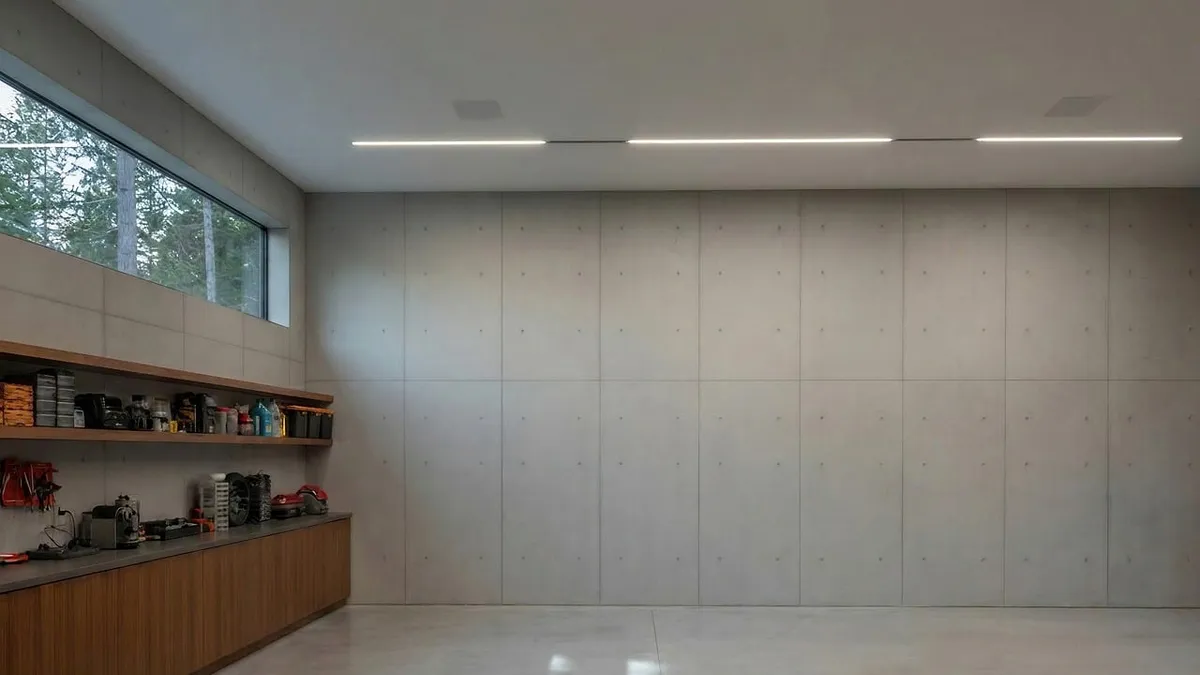
Organize a garage for camping gear by sorting it into four zones based on how fast you actually need to grab each item, not by item type. Put every-trip gear (cooler, chairs, daypack) on an eye-level shelf you can clear in under 30 seconds. Put frequent gear (tent, sleeping bags, stove) on wall shelving or slatwall you can reach in 1-2 minutes. Put seasonal gear (winter layers, a spare tent, off-season bins) on overhead or back-wall space, and keep fuel canisters and propane in a ventilated spot away from heat and the parked car.
Key takeaways
- Sort gear by time-to-grab, not category: every-trip (under 30 seconds), frequent (1-2 minutes), seasonal (3-5 minutes), and fuel/hazmat (ventilated, away from heat).
- A standard two-car garage (20 x 20 ft, 400 sq ft) has room for all four zones without blocking the parked car — the printable zone map below shows where each one goes.
- Vertical space (wall shelving, slatwall, ceiling racks) does more work than floor space in most garages.
- Fuel canisters, propane and cleaning chemicals need their own ventilated spot, never stacked with daily-use gear near a heat source.
- Re-check the zones each season — gear moves between zones as how often you use it changes.
What’s the Fastest Way to Organize a Garage for Camping Gear?
Most garage-organization advice says to “declutter and add shelves,” which doesn’t tell you where any specific item should actually go. A faster method is to sort gear into four zones by how quickly you need to be able to grab it, then build storage around those zones instead of around item categories.
This matters because camping gear gets used in bursts: everything comes out at once before a trip and goes back at once after it. A zone system built around retrieval speed keeps the items you touch every trip within arm’s reach and pushes rarely-touched items out of your way, instead of treating a tent and a pair of snowshoes as equally important just because they’re both “camping gear.”
This garage plan is one piece of a larger storage system — if you’re also figuring out where to keep gear in a closet, shed or apartment, start with our complete camping gear storage system guide and come back here for the garage-specific layout.
How Do You Decide Which Zone Each Item Belongs In?
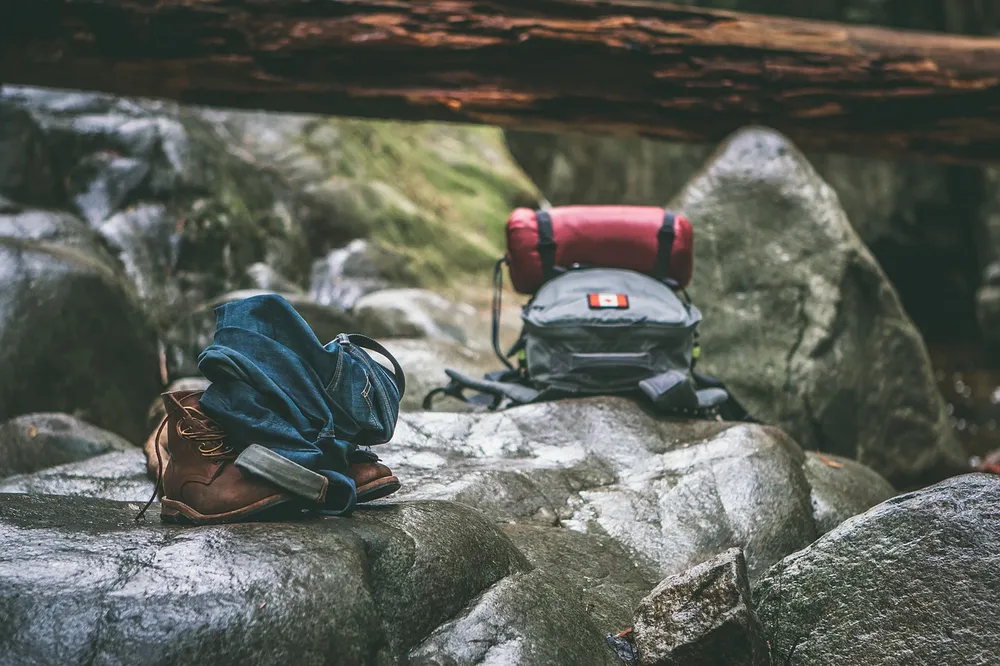
Ask one question for every item: “If I were loading the car for a trip right now, how long would it take me to find and grab this?” That answer sorts the item into one of four zones.
| Zone | Target grab time | Typical gear | Where it lives |
|---|---|---|---|
| Zone 1 — Every trip | Under 30 seconds | Cooler, camp chairs, daypack, headlamp, lighter, basic first-aid kit | Eye-level open shelf or hooks right next to the door you use to leave the house |
| Zone 2 — Frequent | 1-2 minutes | Tent, sleeping bags, sleeping pads, camp stove and fuel bottle, cookware | Wall shelving or a slatwall panel at working height along a side wall |
| Zone 3 — Seasonal | 3-5 minutes, step stool okay | Winter-only layers, a spare or backup tent, holiday or off-season bins | Back-wall shelving above eye level, or overhead ceiling racks |
| Zone 4 — Fuel and hazmat | Not graded for speed — graded for safety | Propane and fuel canisters, bug spray, cleaning chemicals | A ventilated spot away from the furnace, water heater, and any ignition source |
If an item doesn’t fit cleanly — you use it on about half your trips, say — put it in the faster zone. It costs you a little shelf space; it’s worse to make yourself dig for something you actually need on short notice. For the broader question of whether the garage is even the right room for a given piece of gear, see our comparison of shed vs. garage vs. closet storage.
How Much Garage Space Do Camping-Gear Zones Actually Need?
You don’t need a dedicated room. A standard one-car garage runs about 12 x 20 ft (240 sq ft), and a standard two-car garage runs about 20 x 20 ft (400 sq ft), both typically with an 8 ft ceiling. That’s enough depth to run all four zones along the walls and ceiling without touching the floor space a vehicle needs (roughly 9 x 18 ft per car).
The zone map below lays this out for a standard two-car garage. Print it and tape it to the inside of the garage door as a reference while you set up shelving, or while you’re deciding where a new item should live.
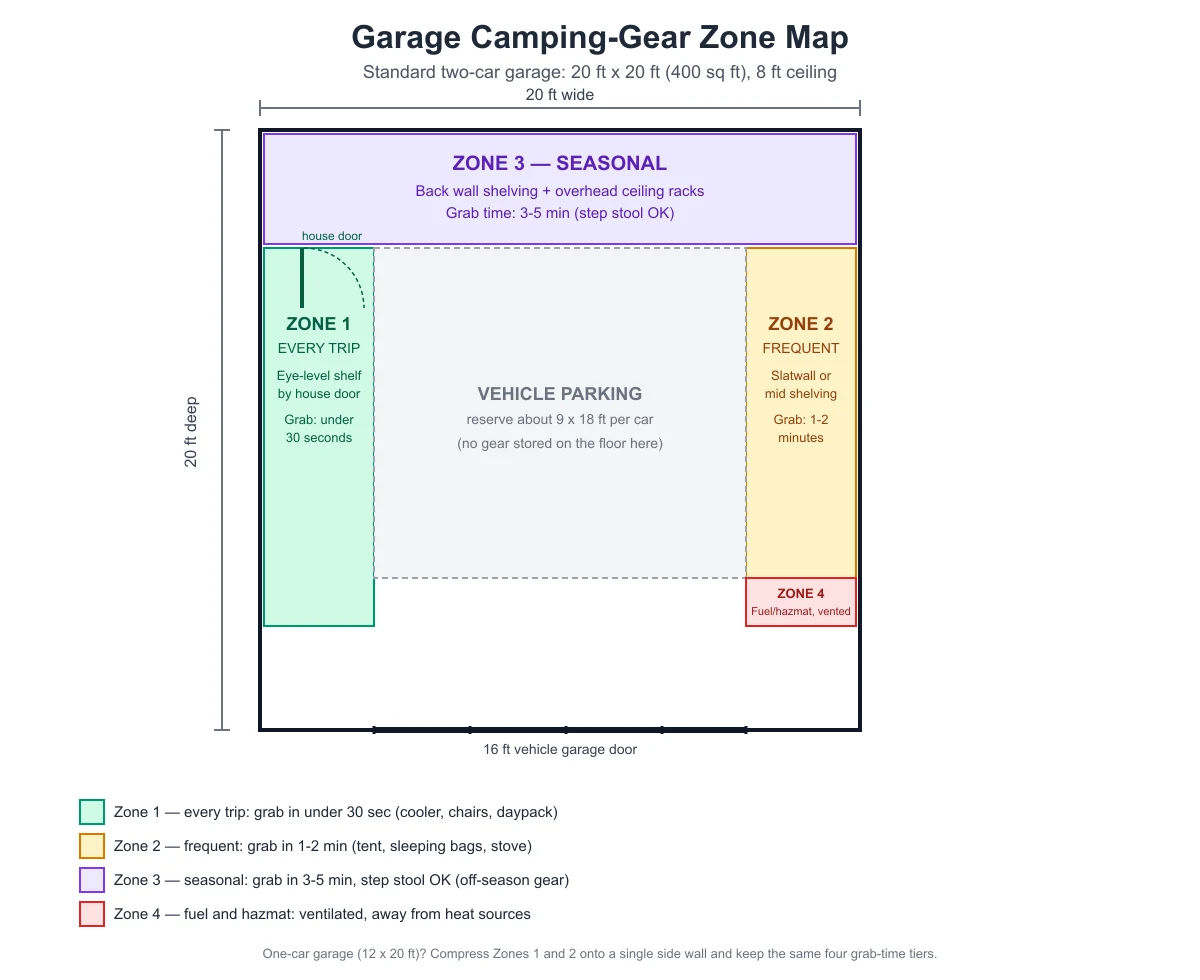
If your garage is a one-car size (about 12 x 20 ft), compress Zones 1 and 2 onto a single side wall — you’ll still have the same four grab-time tiers, just stacked closer together. The point of the map isn’t the exact square footage; it’s assigning every wall and the ceiling a job before you buy a single shelf.
What Storage Methods Work Best in Each Zone?
The method matters less than matching it to the zone’s grab-time target:
- Zone 1 (every trip): open shelving or a few sturdy hooks at eye level. Anything with a lid or a door adds seconds you don’t want here.
- Zone 2 (frequent): wall-mounted shelving or a slatwall system with hooks and baskets. Slatwall panels let you rearrange hooks as your gear list changes, which matters more here than in the slower zones.
- Zone 3 (seasonal): labeled, lidded bins on back-wall shelving or ceiling-mounted racks. Keep shelves narrow rather than deep — a deep shelf collects a second, hidden layer of stuff behind the first, which defeats the point of a seasonal zone you’re only visiting a few times a year.
- Zone 4 (fuel and hazmat): a small, well-ventilated cabinet set apart from the workbench, the furnace, and any pilot light or electrical panel. Keep it off the floor if your garage ever floods.
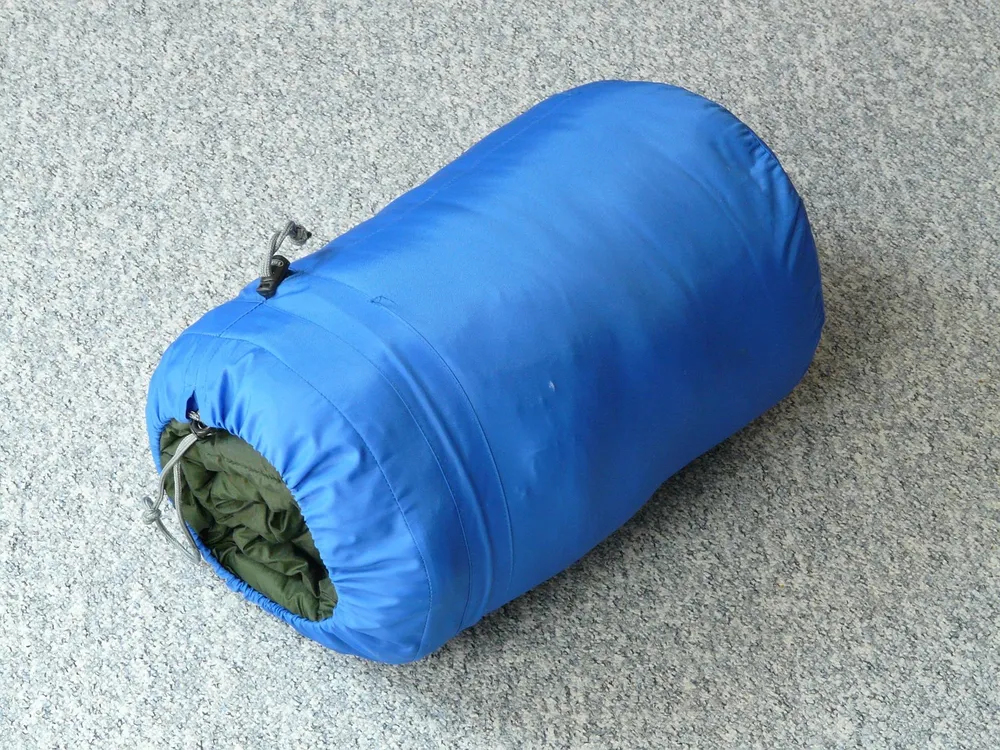
For the full list of what to pull out and inspect before and after each trip, pair this zone setup with a seasonal camping gear storage checklist so gear goes back into the right zone clean and dry, not just shoved onto whichever shelf is closest.
How Do You Keep Garage-Stored Camping Gear Dry and Pest-Free?
A garage is not climate-controlled, so moisture and pests are the two real risks, in every zone.
For moisture, the Environmental Protection Agency recommends keeping indoor relative humidity below 60 percent, ideally between 30 and 50 percent, to prevent mold growth. In a garage, that means leaving a small air gap between shelving and the wall so air can circulate behind stored gear, and running a dehumidifier if your garage regularly feels damp. Never store gear while it’s still wet or damp from the last trip — dry it first.
For pests, mice will chew into nylon tents and nest inside sleeping bags left loose on an open shelf. Store soft goods (tents, sleeping bags, clothing layers) in hard-sided, tight-lidded bins rather than on bare shelves, and clean cookware thoroughly so no food smell lingers in Zone 2 or Zone 3 storage. This is especially important in the slower-access zones, since you’re less likely to notice a problem early.
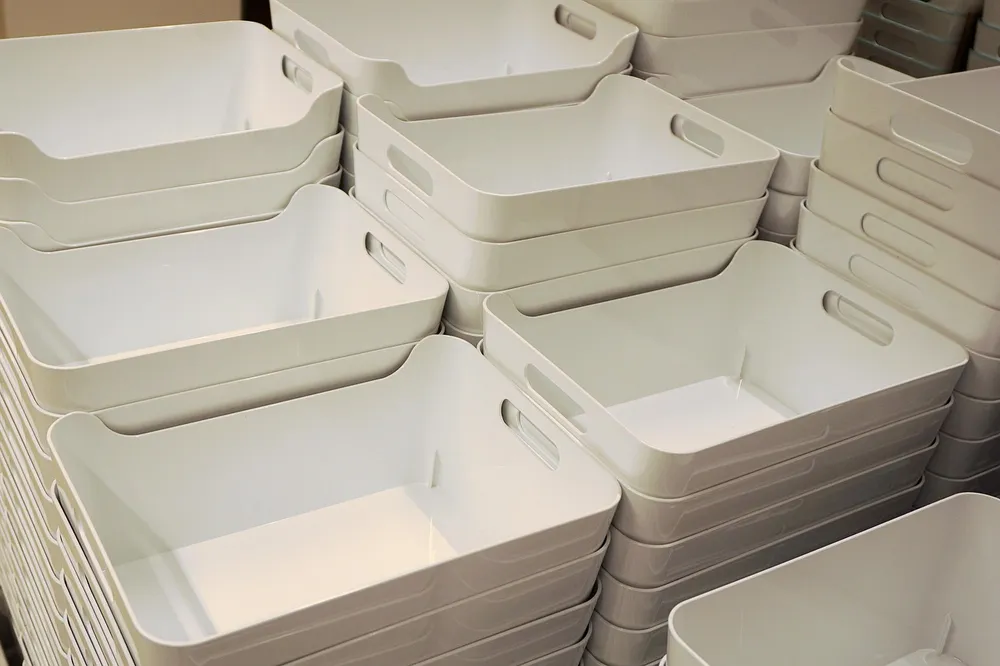
If your garage runs consistently damp or you’re dealing with an active pest problem, that’s usually a sign the garage isn’t the right room for certain gear at all — see our full comparison of shed, garage and closet storage for how each location handles humidity and pests differently.
Where Should Fuel Canisters and Propane Go?
Fuel canisters and propane get their own zone instead of sitting in Zone 2 next to the tent and stove, because the storage priority for them is safety, not speed. Keep them upright, in a cool and ventilated spot, away from direct sun, the furnace, a water heater’s pilot light, or any electrical panel. Follow the storage instructions printed on the canister itself, and if you’re considering storing a larger propane tank (not a small backpacking canister) in an attached garage, check your local fire code first — some jurisdictions restrict larger tanks in attached garages regardless of ventilation.
Keep this zone physically separate from the rest of your camping gear, even if that means it’s a little less convenient to reach. A few extra seconds at pack-up time is a reasonable trade for keeping an ignition source away from flammable fuel.
Frequently Asked Questions
Can I store camping gear in an unheated garage?
Yes, for most gear. An unheated garage is fine for tents, sleeping bags, cookware and similar items as long as they’re clean, dry, and kept off the floor in sealed bins. Items that are sensitive to hard freezes or repeated temperature swings, such as some batteries or liquid fuel, are better moved to a closet or another climate-controlled space.
How do I keep mice out of my garage camping-gear zone?
Use hard-sided plastic bins with tight-fitting lids instead of open shelving for soft goods like tents and sleeping bags, and clean food residue off cookware before storing it. Keep bins a few inches off the concrete floor on a shelf or small riser, since that also helps with dampness.
How much garage space does a family actually need for camping gear?
There’s no fixed number, but the four-zone layout above fits comfortably into a single-car (about 12 x 20 ft) or two-car (about 20 x 20 ft) garage without taking any floor space away from a parked vehicle, since every zone is wall- or ceiling-mounted.
Should I use open shelving or bins with lids?
Match it to the zone. Zone 1 (every trip) works best open, since a lid just adds time. Zones 2 and 3 work better with labeled, lidded bins, which protect against dust, moisture and pests during the longer stretches between uses.
What if my garage doubles as a workshop or storage for other things?
Give camping gear its own clearly bounded zones rather than letting it mix with tools or holiday decorations on the same shelves. A shared garage still works with this system — it just means Zones 1-3 might take up less wall space than shown on the map, scaled down to fit what’s left after other household storage.
Sources
- US Environmental Protection Agency — A Brief Guide to Mold, Moisture and Your Home
- This Old House — Create Your Own Garage Storage Plan
- Reolink — Standard Garage Size (1-3 car dimensions)
campstorageguide.com Editorial Team. Last updated: November 12, 2026.